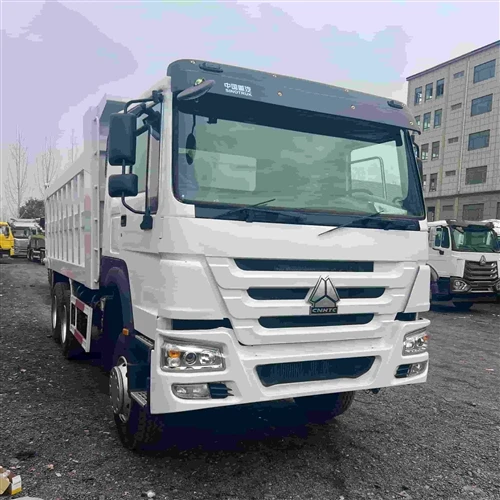
Dump trucks, a crucial piece of equipment in the construction transportation sector, were originally designed to utilize hydraulic systems to automatically dump the cargo compartment, significantly improving the loading and unloading efficiency of bulk cargo (such as sand, coal, and earth). However, dump trucks can be subdivided into various types based on their purpose, structure, and powertrain, each with significant differences in application scenarios, technical specifications, and performance. This article will systematically explain the core differences between different dump trucks based on four key dimensions: powertrain type, compartment structure, lifting method, and usage scenarios.
I. Classification by Powertrain Type: Fuel-Powered and New Energy Dump Trucks
Traditional dump trucks are primarily powered by diesel engines, relying on the high torque output of internal combustion engines to meet heavy-duty requirements. These vehicles feature mature technology, strong gradeability (typically reaching a maximum grade of 30%-35%), and large fuel tank capacities (typically 200-400L), making them suitable for long, continuous operations. They are widely used in mines, large infrastructure construction sites, and other applications where load capacity and endurance are critical. However, their drawbacks are also significant: high exhaust emissions (before the implementation of the China VI standard, some older models emitted nitrogen oxides 5-8 times the standard), high noise pollution (idling noise is approximately 85-95 decibels), and operating costs are affected by fuel price fluctuations.
In recent years, with the advancement of the "dual carbon" policy, new energy dump trucks (pure electric and hydrogen fuel cell) have gradually gained popularity. Pure electric models utilize large-capacity lithium battery packs (typically 282-423 kWh) and are directly driven by an electric motor. They operate with zero emissions (no exhaust particulate matter) and a noise level below 70 decibels (over 25% lower than fuel-powered vehicles). They are particularly suitable for areas with strict environmental requirements, such as urban construction waste transfer and municipal engineering projects. However, due to the limitations of current battery technology, their full-load range is generally 150-300 kilometers (this can be reduced by 30%-40% in low winter temperatures), and charging times are relatively long (1-2 hours for fast charging and 8-10 hours for slow charging), making them more suitable for short-distance, high-frequency transport. Hydrogen fuel cell dump trucks use hydrogen as fuel, generating electricity through an electrochemical reaction. They offer the advantages of zero emissions and a long range (400-600 kilometers on a single hydrogen refueling). However, the current low coverage of hydrogen refueling station infrastructure limits their application.
II. Classification by Cargo Structure: Rear-Tipping, Side-Tipping, and Three-Sided Dumping
The direction of cargo lift is a key design difference in dump trucks. The most common rear-tilting dump truck (accounting for over 80%) has a cargo compartment connected to the chassis via a rear hinge. A hydraulic cylinder tilts the compartment rearward around the hinge (typically a 45-60° dumping angle). This design is simple and highly reliable (with a failure rate of less than 5%). During unloading, cargo slides naturally by gravity, requiring no additional assistance, making it suitable for transporting most bulk materials. However, rear-tilting dump trucks require a relatively high level of clearance behind the truck to avoid collisions with obstacles, and their operation is limited in confined areas such as tunnels and forest roads.
A side-tipping dump truck, on the other hand, hinges on one side of the truck bed (usually the right side). A hydraulic cylinder tilts the truck bed sideways (to an angle of approximately 30°-45°). This advantage is that the vehicle can be parked directly alongside the road without turning during unloading, making it particularly suitable for applications where roads are narrow (such as rural dirt roads and mining sidings) or where quick unloading to a roadside pile is required. However, a side-tipping dump truck requires higher structural strength (lateral forces are 30%-40% greater than those of a rear-tipping dump truck), resulting in a 15%-20% increase in manufacturing costs. Long-term use can also lead to deformation of the truck bed walls (requiring regular weld strength testing).
Three-side tipping dump trucks are custom-built models with hydraulic support structures on all sides of the bed, allowing them to dump to either side or the rear as needed. These trucks are often used in applications such as bulk cargo terminals and grain storage facilities, where precise control of unloading direction is crucial-for example, to divert material onto two conveyor belts or to prevent contamination of specific areas (such as construction sites near buildings). However, the hydraulic system complexity doubles (requiring multiple independent control valves), resulting in higher maintenance costs (annual costs are 20%-30% higher than conventional models), and market penetration is less than 5%.
III. Classification by Lifting Method: Front-Tap, Mid-Tap, and Rear-Tap Hydraulic Systems
Dump trucks rely on hydraulic systems for lifting, and the location of the hydraulic cylinders directly affects the load distribution and lifting stability of the vehicle body. In front-tap dump trucks (the mainstream design), the hydraulic cylinders are located behind the cab, below the front end of the vehicle body, and dumping is achieved by pushing forward and upward on the bottom of the vehicle body. This layout shifts the center of gravity of the vehicle body rearward (reduced by 10%-15% compared to rear-tap dump trucks), resulting in a smoother lifting process (especially when fully loaded, with less than 5° of vehicle sway). The hydraulic piping is also simplified (shorter length and fewer bends), resulting in a lower failure rate (accounting for approximately 3%-5% of vehicle failures). However, the front-tap design places higher demands on the strength of the front section of the vehicle frame (requiring additional reinforcement), and failure of the hydraulic cylinder seal can cause the front end of the vehicle body to suddenly sink, posing a safety hazard.
The hydraulic cylinder of a center-top dump truck is installed below the center of the vehicle bed (typically 1-1.5 meters from the centerline of the frame's longitudinal beams). Tipping is achieved by vertical lifting. This advantage is uniform load distribution on the vehicle bed (stress differential between the front and rear ends is less than 5%), making it suitable for transporting dense, hard materials such as iron ore and construction waste. It also reduces the risk of deformation (after long-term use, the flatness deviation of the bed floor remains within 2mm). However, the hydraulic cylinder stroke of a center-top dump truck is longer (15%-20% longer than that of a front-top dump truck), resulting in a relatively slow lifting speed (a fully loaded lift takes approximately 12-15 seconds, 2-3 seconds slower than a front-top dump truck). It also requires more space in the center of the vehicle bed, potentially compromising battery pack or driveshaft layout.
The hydraulic cylinder of a rear-top dump truck (gradually phased out) is located below the rear of the vehicle bed and dumping is achieved by pushing upward and backward. This design was originally used for light-duty dump trucks (load capacity ≤ 5 tons). However, due to concentrated stress on the rear end of the truck bed (peak stress is 25%-30% higher than that of front-lift trucks), long-term use can easily lead to cracking of the tailgate (repair frequency is over three times higher than other types). Furthermore, the front of the truck bed can tilt forward due to inertia during lifting (requiring additional limiters). Currently, only a few low-end models adopt this design.
IV. Classification by Application: Mining, Engineering, and Urban Sanitation
The performance requirements for dump trucks vary significantly across different applications, leading to the development of specialized models. Mining dump trucks (such as wide-body trucks) are designed specifically for open-pit mines. They typically have a load capacity of 30-100 tons (maximum capacity: 150 tons). They feature a reinforced frame (8-12mm thick, compared to 6-8mm for standard engineering trucks), a wear-resistant steel body (surface hardness HRC 45-55, compared to HRC 30-40 for standard vehicles), and large tires (1.4-1.6 meters in diameter, increasing load capacity by 40%). Their hydraulic system operates at a higher pressure (20-25 MPa, compared to 16-18 MPa for standard models), ensuring stable lifting even under heavy loads. However, they operate at a slower speed (maximum speed 40-50 km/h) and require frequent maintenance (hydraulic oil changes every 500-800 hours of operation).
Engineering dump trucks (such as those used on urban construction sites) focus on flexibility and adaptability, with load capacities typically ranging from 10-30 tons. They feature a shorter wheelbase (3.5-4.5 meters, 1-1.5 meters shorter than mining trucks), a tight turning radius (≤8 meters, making them easier to maneuver in tight construction sites), and a moderate cabin volume (12-20 cubic meters). Their suspension system often utilizes a leaf spring + shock absorber combination (balancing load capacity and comfort), and optional anti-splash guards are available to reduce material spillage during unloading.
Urban sanitation dump trucks (such as garbage transfer trucks) focus on environmental friendliness and ease of operation. Their cabins are coated with an anti-corrosion coating (to prevent leachate corrosion) and equipped with automatic tarpaulins (to reduce odor during transport). Hydraulic system noise is controlled below 65 decibels (to avoid disturbing others). These trucks have a smaller load capacity (5-15 tons) but require frequent starts and stops (average daily operations ≥10 times). Therefore, low-speed, high-torque engines (or pure electric systems) are preferred to reduce fuel consumption and wear.
Conclusion
The differences among dump truck types are essentially the result of a balance between functional requirements and technical constraints. The transition from fuel to new energy powertrains, structural innovations from single-tip to multi-directional dumping, hydraulic optimization from rough lifting to precise control, and customized designs for different scenarios all constitute the core threads of dump truck technology development. When selecting a dump truck, users should comprehensively consider load requirements, operating environment, environmental requirements, and cost budget to find the most suitable model and maximize efficiency and benefits.